AI Stocks vs Bitcoin in 2026: Where Is the Smart Money Actually Going?
June 7, 2026
Something unusual is happening in 2026: stocks and crypto are moving in opposite directions, and the gap is widening.
The S&P 500 hit fresh record highs in May. Nvidia is up roughly 16% year-to-date and posted $81.6 billion in quarterly revenue. Meanwhile, Bitcoin shed about 40% from its October 2025 peak, and spot ETFs logged $3.1 billion in year-to-date outflows. AI infrastructure stocks are printing returns that are pulling capital away from crypto at scale - and miners are even pivoting their own hardware toward high-performance computing instead of Bitcoin.
This isn't a temporary blip. It's a capital rotation story. And if you're holding both assets - or deciding between them - here's what the data actually says.
What's Driving AI Stocks Right Now
The AI trade has one engine: infrastructure spending that isn't slowing down. McKinsey projects global AI infrastructure spend will hit $7 trillion by 2030. Nvidia, which controls an estimated 92% of the data center GPU market, reported 73% year-over-year revenue growth in its last quarter. Jensen Huang says the company has over $1 trillion in visibility for its Blackwell and Rubin platforms through 2027.
That kind of forward visibility is rare for any asset class. Equity investors are pricing in years of compounding growth - and so far, the earnings are backing it up.
Beyond Nvidia, the rally is widening. DigitalOcean is up 240% in 2026 after pivoting aggressively into AI services. Nebius - a company Nvidia itself invested in - is up 73%. The AI trade has moved well past one stock.
What's Weighing on Bitcoin
Bitcoin's problems in 2026 are partly macro and partly structural. The same capital hunting for AI returns is explicitly leaving crypto. In the week ending May 26 alone, digital asset products saw $1.47 billion in outflows - the largest single-week BTC outflow of the year. Analysts at K33 described the setup as a "choppy summer" with no obvious catalyst to reverse the trend.
The structural issue: Bitcoin ETFs were supposed to be a one-way valve, constantly absorbing supply. When institutional money reverses and those ETFs see sustained outflows, selling pressure compounds mechanically. Lower prices trigger more outflows, which trigger lower prices.
There's also a narrative competition. In 2021, Bitcoin was the "high conviction" asymmetric bet for institutional allocators. In 2026, that role is being shared - or in some cases replaced - by AI infrastructure plays that come with cash flows, earnings reports, and analyst coverage.
The Long Game: Bitcoin Still Wins on Returns
None of this means Bitcoin is dead as an asset.
Over a five-year horizon, $10,000 in Bitcoin grew to roughly $46,200 - versus $23,500 in the Nasdaq 100 and $19,600 in the S&P 500. Over ten years, that same $10,000 in BTC became approximately $830,000, against $50,000 in the Nasdaq.
The volatility that makes Bitcoin painful to hold in a downturn is the same volatility that generates those returns. The question isn't which asset is "better" - it's how much of each you hold, and whether you can see the full picture clearly when markets get noisy.
The Real Problem: Most Investors Are Flying Blind
Here's what the AI stocks vs Bitcoin debate misses entirely: most people don't hold one or the other. They hold both - plus cash, plus maybe some index funds, plus a savings account.
And when Bitcoin drops 20% while Nvidia is up 15%, the typical reaction is to open two separate apps, feel conflicted, and make a decision based on whichever chart you looked at last.
That's not investing. That's reacting to noise.
The investors who navigate rotations like this without panic are the ones who can see their actual portfolio allocation at a glance. When you know that your BTC is 10% of your net worth and your AI stocks are 15%, a 20% BTC drop is a 2% net worth move. Manageable. When those positions live in different apps and mental buckets, the same drop feels like a crisis.
How Yavo Helps You Track Both
I built Yavo because I was living this problem. Bitcoin in one app, stocks in another, cash somewhere else - no single view of what any market move actually meant for my finances.
Yavo tracks your crypto, stocks, and cash in one place with live prices. Connect your assets once and your real net worth updates automatically as markets move. No more switching between apps. No more mental math.
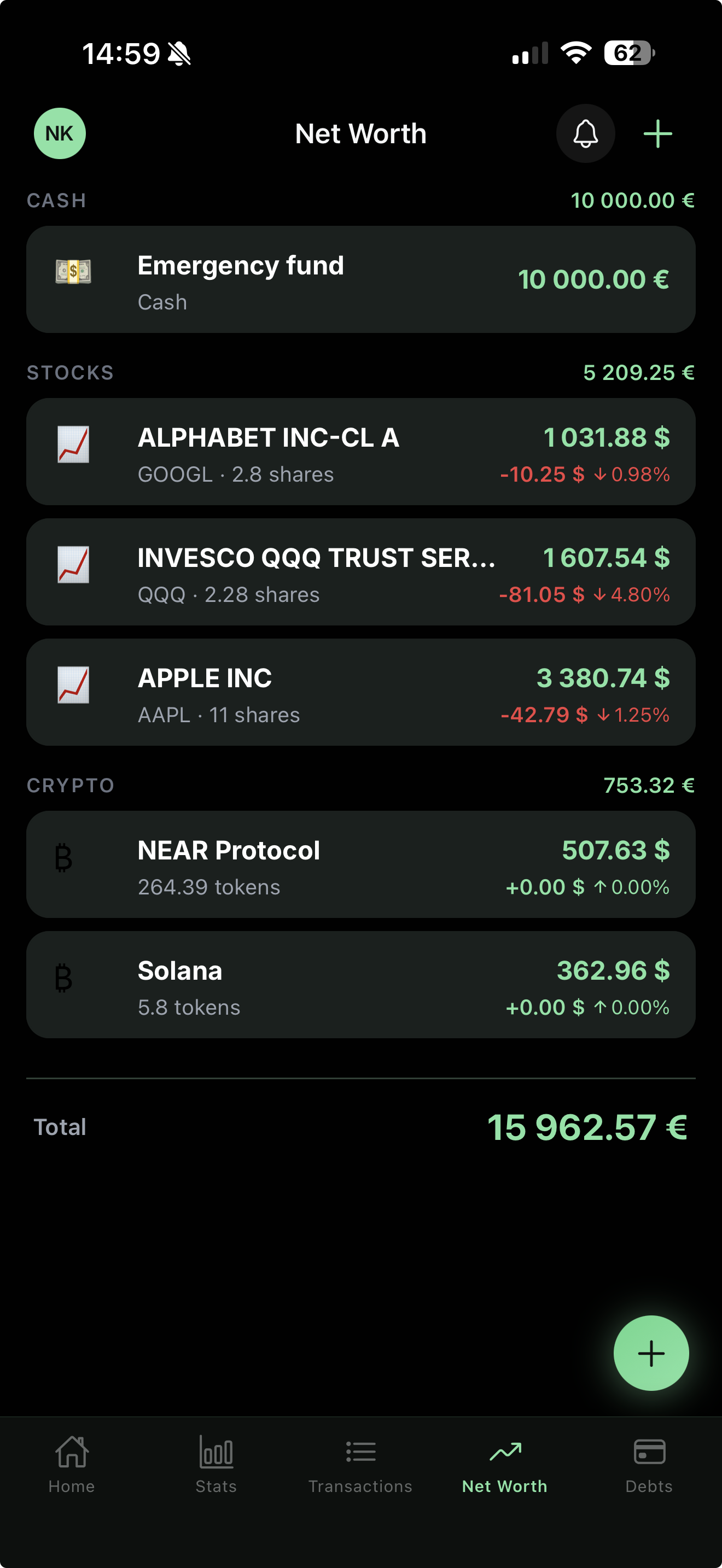
What that gives you when capital is rotating between AI and crypto:
- Your real allocation - exactly what percentage of your net worth is in each asset class
- The actual impact - what a 20% BTC drop or a 15% NVDA rally does to your number, not just the tickers
- One clear picture - crypto, stocks, and cash together, updated in real time
See where you actually stand - Download Yavo →
The Bottom Line
AI stocks and Bitcoin are in a real divergence in 2026, and the data suggests it's driven by structural capital rotation, not just sentiment. Both assets have legitimate long-term cases. The mistake is treating this as a binary choice - or worse, making decisions about one without knowing what it means for everything else you own.
The question isn't AI or Bitcoin. It's whether you have a clear enough picture of your full portfolio to act rationally when the rotation hits.
Sources: TokenPost · TECHi · CryptoDaily · CryptoBriefing · Motley Fool · Intellectia · MacroTrends
Track your expenses with Yavo - free to download